
Unlocking Postpartum Depression in rural Bihar
Basanti Devi rests by her small thatched hut with a two-week old baby. For 19 year-old Basanti, this is her second unwanted child in consecutive years. Being anaemic, her child weighed merely 1950 gms as it was preterm birth. Post-delivery, she left early from the government health facility fearing squander of her savings, as she was asked to fetch an out of stock drug from market.
“When can I go to get grass?” a weary eyed Basanti asked Swetanjali (community health worker) as a neighbour arranged feed for her small ruminants. Her concern is genuine as her postpartum (post-pregnancy) recovery is delayed due to complications, sleep is compromised at night due to emotional distress, while elder daughter consumes her day’s peace. Basanti stays alone with her children, surviving through meagre remittances from husband, who works as a mason in a metropolis.
Several such women as Basanti, narrate the many indescribable changes to their life post pregnancy. Nearly half[1]of all adolescents are married early, thus leading to early conception, further compromising their agency and autonomy. Young girls with unmet needs of family planning struggle to live up with the collective social expectations. They are unable to confide in others, as network of old friends is lost and newer alliances cannot be formed due to restrictive social sanctions. Her coping mechanism gives in when faced with wide gamut of problems that she has no solutions to, not even an empathetic ear, forget an open heart and mind.
Such woman can slip into postpartum depression (PPD), when they start to lose sense of reality, feel irritated, find difficulty in associating events, are emotionally pained or possess thoughts of self-harm, within 4 weeks of giving birth or as late as 30 weeks. It disrupts their daily routine, impairs cognition and induces withdrawal. In certain cases, perinatal (pre-birth, during pregnancy) depression transforms to postpartum depression. Thus, an effective intervention design must consider building resilience amongst pregnant woman and preventing PPD in young mothers.
Setting Up Treatment at Home
An approach to treat PPD has been found in cognitive behaviour therapy (CBT). It has proven potential in resource-constrained settings, wherein local community health workers are trained to screen clients and deliver counselling sessions at clients’ home, when found positive for PPD. Selection of sessions for counselling and their chronology is derived from the relative risk factors (poor nutrition, complications during pregnancy & after birth, family estrangement, lack of personal care and rising distress) assessed during screening of client. Merely adjusting to clients’ time is significant for rapport-building and re-assuring that she is cared by one. Something very small but remained a distant dream otherwise.
All this requires consistent training of local community health workers (mostly ASHAs) but they are disenchanted with the health system for their long-pending entitlements. After facing the customary resistance, our concept impressed them when they could time travel back and realise that postpartum psychiatric disorders (that usually includes blues, occasionally transforms to depression and rarely into psychosis) had affected them in the past. Soon, it became a subject of poignant interest and surprisingly filled them (us too) with thrill to learn and engage with other community women.
Winning ASHAs confidence and interest, got our tough job a notch lighter and certainly joyful. We sieved out and deconstructed all relevant jargons employed in CBT techniques to local dialect for conceptual clarity, packed them up with illustrations, developed role-play exercises and ensured active participation. Simple single page forms were designed to document session learnings, challenges and techniques employed by counsellors. As training progressed, confusions mounted on usage of most appropriate techniques in certain situations. This called for more rigorous practice and our battery of counsellors undertook it all. By now, we were convinced that we could not have found a better resource than them and were good to go.
Follow up home-visits were scheduled fortnightly, wherein previous experience is reflected by the counsellor and counselee. The idea is to help the client find her strengths and make her believe in her decisions. For ease of acceptance, practice of including a family member / neighbour is encouraged as session’s progress. This not only ensures supportive supervision but also brings comfort and confidence amongst family members who felt skeptic about sessions.
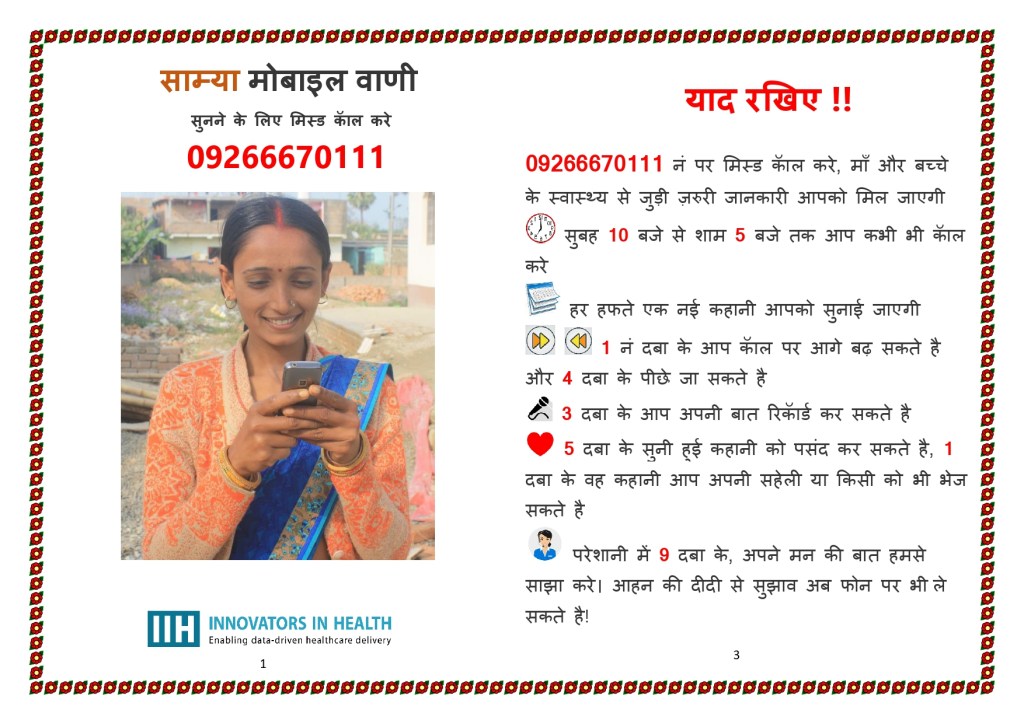
Besides, we tested the efficacy of mobile technology in combating PPD with similar content in form of audio dramas, which was never tried. The deep penetration of mobile phones in rural households was harnessed, for delivery of free audio content at fixed intervals. This mhealth intervention was conceptualised to assess, if clients reported early or better recovery when provided with another layered service, apart from receiving home-based counselling session. Tapping onto the best technological resources nationally & pooling local strengths, we developed an audio platform with a dashboard, connected to a central server. Script-writing and recording was ensured by local team on a low-cost crate developed for sound-proofing. Post-edit on an open-access software, our episodes were good to publish.
The intervention was received with aplomb in the community, contrary to our fear of falling apart. Listeners were not just staying longer to listen a repeat of same content but were also sharing it to their peers and relatives in other geographies, something that we learnt later. The service clocked over 4000 calls in a span of 6 months with average listenership being around 5 min/call. This was an unprecedented feat for us on multiple ends. Women with no depression frequently used the mhealth intervention, their higher usage of the service prevented them from being mildly depressed. This received critical acclaim from several quarters, as it was made possible in a state that is highly under-resourced with mental healthcare professionals and facilities.
Our foot soldiers of CHWs and their locally developed tech interface prevented mothers from being depressed and build their resilience against PPD. In underserved communities as ours, this can be a boon if existing systems are strengthened and technology is used to augment efforts.
[1]National Family Health Survey-4 (2015-16) places Bihar amongst the top states that report early marriages in the country, while Samastipur district recorded 52.3% marriages <18years
Blog by: Homam
 Innovators In Health